channelmoa vs Generic IPTV Services: A Comparison Framework You Apply Yourself
Compare channelmoa with any IPTV service using criteria you can check yourself: legal transparency, devices, pricing, trials, refunds, support, and privacy.
Published by the channelmoa editorial team. This is first-party content published by channelmoa. It explains a neutral comparison method, identifies only information visible in this project, and does not claim channelmoa is universally better than another provider.
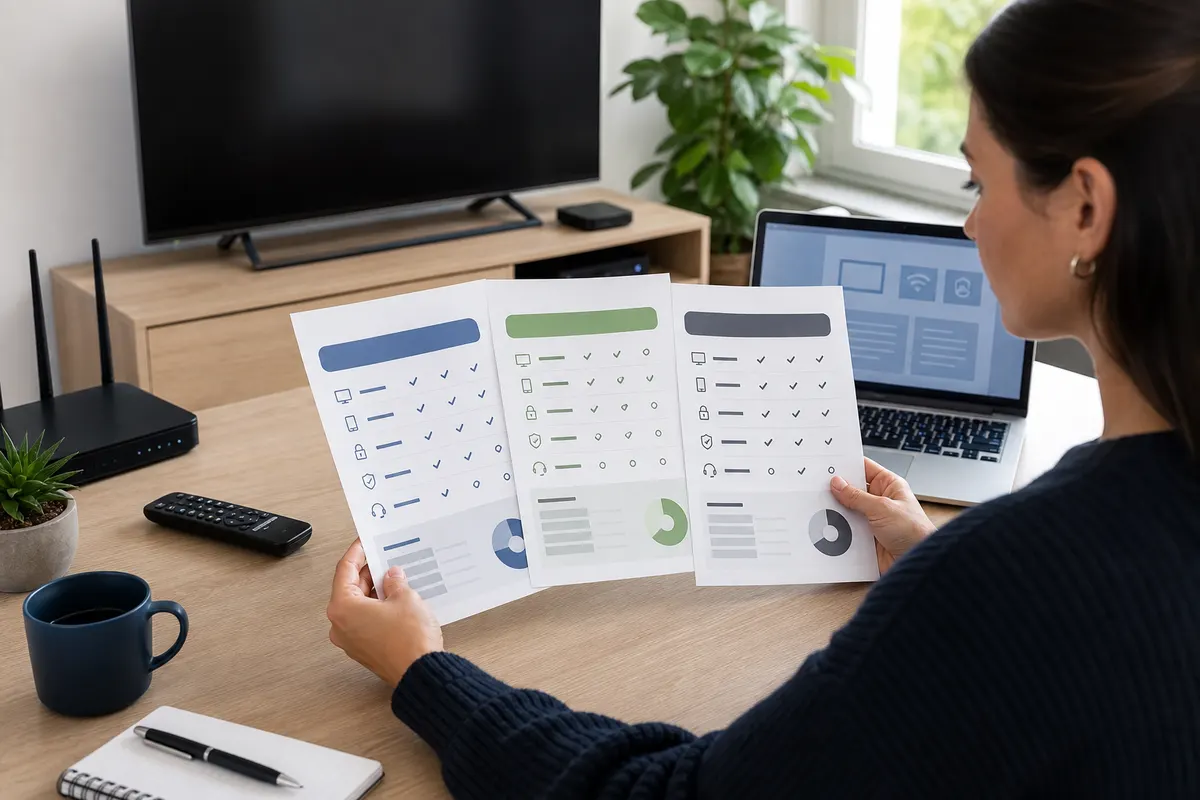
| Criterion | Evidence to collect | channelmoa evidence visible here | Evidence required from another provider |
|---|---|---|---|
| Legal transparency | Rights-aware regional wording, terms, business identity | Website positions the service as legal and provides terms and contact pages; this is a statement, not independent verification of every right | Equivalent current terms and a clear answer about lawful availability in the viewer's country |
| Device compatibility | Exact device, OS, store, app, and login method | Apps and blog guidance describe device workflows; exact compatibility still requires confirmation | Written support for the exact model, region, app listing, and account method |
| Pricing | Currency, duration, renewal amount, device limits, extras | Package information displayed on the site at the time of review | A dated written quote and complete renewal or cancellation conditions |
| Trial and refunds | Eligibility, duration, scope, deadline, refund route | Trial language is visible; buyers should request the applicable written terms | Published or written terms that can be saved before payment |
| Support | Channels, hours, scope, escalation, credential safety | Contact details and setup guidance are visible; response quality must be tested by the reader | A pre-sale answer to one exact-device question and a documented escalation route |
| Privacy and security | Privacy notice, data requested, access controls, deletion | A privacy page is linked; readers should review the current text | Current privacy information and an explanation of why each requested data item is needed |
| Limitations | Regional, content, concurrency, maintenance, and device constraints | The blog repeatedly notes regional and device variation | Clear written limitations rather than universal availability promises |
What this comparison can and cannot prove
This article is published by channelmoa, and it discusses channelmoa alongside the broad, unnamed category of generic IPTV services. That relationship is a commercial interest a reader should not have to dig for, so it is stated here directly: a provider comparing itself to a category it belongs to cannot be treated as a neutral judge of the outcome. What it can offer is a repeatable method — criteria you can apply to channelmoa and to any other lawful provider yourself, using the same standard for both.
A useful comparison rests on facts that can be saved and checked: the accountable operator, applicable country, package duration, total price, renewal process, supported device and app, session limit, trial conditions, refund route, privacy notice, support channel, and known limitations. Marketing adjectives such as premium, stable, fast, trusted, or best answer none of those questions. The phrase generic IPTV service is used only for an unidentified alternative; it does not imply that other providers behave alike, and it is not a substitute for that provider's own documented terms.
Three kinds of statement, not one
Label each note as a verified fact, a first-party statement, or a personal test result. A published price on a dated page is a fact about what that page displayed, not proof the price holds in every country. A successful trial on one television is a personal test result, not proof of universal compatibility. A provider stating it offers legal service is a first-party statement, weighed alongside its identity, terms, and regional explanation — not accepted on its own.
If a provider will not answer a material question, record the absence itself; a missing answer is a valid reason to delay a long commitment even without proof of wrongdoing. Do not treat channel count, a temporary discount, or one fast support greeting as a shortcut — they are easy to advertise and hard to interpret on their own.
Build a dated evidence record before comparing
Give the IPTV provider verification checklist a pass/fail read first — it defines the questions that decide whether a provider is safe to buy from at all. This page assumes that screen has already happened, and turns the answers into a side-by-side record for comparing services that both passed it.
Write your household's requirements before reviewing any offer — the main screen, secondary devices, accessibility needs, viewing hours, and budget — so an irrelevant feature cannot substitute for a missing essential. Then ask channelmoa and every alternative the identical questions: which lawful content is available in your country, which exact app and login method your device needs, how many streams may run together, what renewal costs, and how an unresolved billing issue is escalated. Score comparable forms of evidence — do not credit one provider for a verbal answer while requiring another to publish a formal policy.

Test once, the same way, for every provider
Where a lawful trial exists under written terms, test it at the screen and hour you normally watch: sign-in, catalog loading, remote navigation, guide timing, live and on-demand playback, and a full close-and-reopen. A trial result is evidence about that configuration and window only — not a guarantee of future uptime. Run the identical test on every provider you compare; a different device, time, or title makes the results non-comparable.
Fold in one failure test: send a single concise support request naming the device, app version, connection, and exact symptom, and note whether the reply protects credentials and gives reversible steps. Keep the worksheet after purchase — it becomes the baseline you check the service against at renewal.
Legal transparency: what to check and what's visible here
What it is: how a provider describes lawful availability and regional limits, and whether its stated business identity stays consistent across its domain, contact page, terms, and payment recipient. Why it matters: streaming rights depend on content, territory, and time, so a website's legal wording is not independent proof of a distribution agreement — it is a first-party statement that still needs an answer specific to your country and package.
How to check it: ask the provider a direct rights-and-region question for the content and country you want, then keep the answer with the applicable terms. channelmoa's own about, contact, privacy, package, and terms pages are checkable facts about the site's structure — reading them is not the same as independent verification of every right, and they should be read at their current, live version rather than taken from this article.
What a low score looks like
Reduce confidence when a seller promises every event everywhere, avoids an ordinary rights question, pressures immediate payment, or changes stated identity without explanation. These are purchasing risk indicators, not a legal ruling by the reader — consumers can compare documents and ask questions, but are not expected to audit a licensing chain themselves.
Device compatibility: what to check and what's visible here
What it is: support for your exact chain — television or box model, operating-system version, country, app store, login method, and network — not a page of platform logos. Why it matters: a logo is a starting point, not a compatibility record; an app store listing can differ by region, and an older television's app support can lapse without notice.
How to check it: ask which exact application to install, where to get it, and whether it is available in your region, before assuming a device is supported. On channelmoa, the supported apps and devices page and device-specific setup guides are observable, checkable documentation; whether a specific model and region are covered still needs a direct answer from support, without sending a password to get it.
A useful test
Ask someone who did not configure the device to run the normal sign-in, search, and exit routine. If the documentation only works for the person who wrote it, expect higher recurring support effort — from any provider, including this one.
Pricing and limitations: what to check and what's visible here
What it is: the total price, term, renewal amount, device allowance, and every stated limitation, normalized to the same currency and billing period across every offer you compare. Why it matters: a low headline price is not automatically poor value, and a higher one is not proof of quality — a monthly-equivalent calculation only means something once duration, device rules, and limitations are lined up beside it.
How to check it: read the provider's current package page directly rather than relying on a price quoted in a comparison article, since live commercial pages control pricing, not blog content. List limitations — territorial availability, app-store constraints, session rules, trial exclusions — in the same table as features; a provider that documents a limitation is easier to plan around than one making an unqualified promise.
Use a pass/fail gate before scoring anything
If lawful regional availability, exact-device support, or acceptable privacy terms cannot be confirmed for your case, a high score elsewhere should not override that failure. A cheaper plan that fails a non-negotiable is not a better plan.
Trials, refunds, and support: what's checkable, and what needs a direct answer
Published trial length, refund windows, and support channels are checkable facts you can read before paying. Whether support actually resolves your specific device problem, and whether a refund request is honored smoothly, are judgment calls that a policy page alone cannot settle — they require a real interaction. Digital-service refund rights vary by jurisdiction; do not assume a universal cooling-off period, and consult your local consumer authority when it matters.
The most efficient test of support quality is one precise, safe question, asked before a long commitment: name your exact device, operating system, country, and account method, and ask for the supported path. A useful answer addresses those facts and acknowledges uncertainty where it exists, without asking for a password or an unrelated credential. Keep the order confirmation, the support conversation, and the applicable refund terms as your own record — a promise that cannot be located or saved later is weaker evidence than a narrower written policy.
Where to send that question
For channelmoa specifically, contact channelmoa support with the exact device, country, and plan in question, and request the applicable written terms rather than a verbal summary. Judge the answer the same way you would judge any other provider's: does it name the model and region, or does it just reassure you?
Privacy and security: what to check and what's visible here
What it is: what a provider collects, why, who receives it, how long it is kept, and how a request or deletion is handled. Why it matters: a privacy page is not proof every stated practice is followed, but it is evidence you can read and compare — and a streaming setup does not usually justify access to an unrelated email, banking, or router-admin account.
How to check it: read channelmoa's live privacy page against an alternative's current notice, and note the date and any material difference. Neither this article nor the underlying project contains an independent security audit of channelmoa or anyone else, so treat this category as reviewable documentation, not a security certification — the FTC's small-business cybersecurity guidance and the NIST Cybersecurity Framework describe the general risk-management principles behind that distinction, not a rating of any streaming provider.
A simple incident rule
If a provider requests a credential it does not need, stop and verify the request through a known contact route rather than a link in the message itself. This applies to every provider being compared, this one included.
Score the evidence and decide
Score each category from zero (no usable evidence) to five (documented evidence, a successful test, and a clear limitation or escalation path) — no decimals, and mark non-negotiables like lawful regional availability or acceptable privacy terms as pass/fail gates rather than points to be averaged away. Set the weights for your household before you see any totals, so they cannot be adjusted afterward to favor a preferred seller.
Be honest about what this method cannot do before you pay: it cannot predict a provider's uptime six months from now, guarantee that a trial's performance holds under different network conditions, or substitute for a real support interaction on your exact device. That is what a short first term or a trial is actually for — a bounded, real test of the specific configuration you plan to keep, not a formality before committing to the longest available plan.
The decision this method should be able to reach
The outcome can legitimately be no purchase, a shorter trial, or a different provider — choosing channelmoa is only the right answer here if channelmoa's own dated evidence wins against your predeclared requirements.
Once the comparison is finished and you know which provider you're proceeding with, review the channelmoa packages page for current plan details rather than committing from memory of this article.
A provider comparison scorecard that resists hype
A fair comparison uses the same questions and evidence for every provider. Weight the factors that affect daily viewing and account safety, then revisit the score after real use.
Score legal and regional clarity
Catalog size can distract from whether a provider explains authorized availability and location-specific limitations responsibly. Ask the same rights-aware question of each provider and review terms, service descriptions, and sales messages for consistency.
Evidence to collect: Award points for clear boundaries and realistic answers; deduct them for piracy language or guarantees that ignore territories. Decision rule: Exclude an option when its core offer depends on claims the provider will not substantiate or explain.
Score package transparency
Two similar prices can cover different durations, screens, app costs, renewal rules, and levels of setup assistance. Normalize total cost, monthly equivalent, concurrent sessions, supported devices, activation process, and renewal terms in one table.
Evidence to collect: Use written package information that survives checkout rather than a temporary message or unexplained verbal promise. Decision rule: Prefer the option whose limitations and total customer obligation remain understandable before payment.
Score exact-device guidance
A generic list of platform logos does not prove support for an older model, operating-system version, remote, or login method. Submit the exact same device scenario and compare whether each response names a verified app and realistic preparation steps.
Evidence to collect: Strong guidance anticipates storage, updates, account format, network position, and the point where external hardware is wiser. Decision rule: Deduct heavily when support recommends unknown downloads or cannot distinguish a television model from an operating system.
Score activation completeness
A credential sent quickly is not a complete activation when the customer cannot load data, play content, or understand account limits. Time the journey from order to verified login, playback, guide check, security handover, and known support route.
Evidence to collect: Record how errors are handled and whether the customer retains a reproducible known-good configuration afterward. Decision rule: Value a careful successful handover above an impressive delivery-time claim followed by repeated troubleshooting.
Score diagnostic support
Friendly messages do not solve technical problems unless support can separate account, app, device, network, and delivery layers. Compare response accuracy using one clearly described scenario with model, app, connection, symptom, and time.
Evidence to collect: Good support protects credentials, changes one variable, explains the reasoning, and asks for a useful result. Decision rule: Deduct points for repeated reinstalls, unexplained DNS changes, credential replacement, or requests for unrelated private access.
Score the first month, not day one
Launch discounts and initial attention may not predict guide maintenance, incident communication, renewal clarity, or long-term account care. Review actual playback patterns, household usability, documented support cases, security, and delivered terms after several weeks.
Evidence to collect: Use dates and outcomes so one excellent interaction or temporary outage does not dominate the whole assessment. Decision rule: Choose or renew the service whose complete evidence best fits the household, even if another advertises more raw features.
A practical comparison checklist for choosing the better fit
Begin the comparison with evidence that can be checked before purchase. Score legal and regional clarity, package duration and total cost, supported devices, simultaneous-use rules, activation process, renewal terms, privacy information, and the available support route. Apply the same questions to channelmoa and any generic alternative. A large catalog claim should not outweigh unclear account rules or a checkout identity that does not match the service being discussed.
Support quality is more than response speed. Give each provider the same device-specific scenario and assess whether the answer identifies the operating system, verified app, login method, storage or network preparation, and a safe next step. A quick greeting followed by repeated reinstalls is weaker than a slower answer that isolates the fault. Good support protects credentials, asks for precise evidence, explains why a test matters, and records escalation clearly.
Device compatibility has value when it reaches the exact model and routine. Platform logos do not prove that an older television store still carries the app or that its remote can navigate every field. Compare guidance for the primary screen, secondary device, decoder needs, EPG behavior, and external-player alternatives. channelmoa's apps guidance and setup articles should be judged by whether they help a real household reach and maintain a stable configuration.
Package clarity includes what is not included. Review term, currency, concurrent sessions, activation expectation, regional limitations, renewal, and support scope together. User education also belongs in the comparison: a provider that explains Ethernet testing, app updates, account security, and guide troubleshooting can prevent avoidable cases. Educational material should be specific and consistent with support, not a collection of generic paragraphs designed only to capture search queries.
Trust develops over the first month, not on checkout day. Revisit the scorecard after real use and compare delivered terms, playback patterns, household usability, documented support outcomes, incident communication, and credential handling. Responsible legal framing should avoid universal event guarantees, piracy language, and instructions that bypass ordinary subscriptions. Choose the service whose complete evidence fits the household, even when another option advertises a larger raw feature count or a more urgent discount.
Sources and further reading
Related channelmoa resources
FAQ
Does this article prove channelmoa is better than another IPTV provider?
No. It is first-party content and provides a method for comparing dated evidence. The result depends on the reader's region, device, requirements, terms, and lawful test results.
What evidence should I collect before paying?
Collect current terms, privacy information, plan price and duration, renewal method, trial and refund conditions, exact-device support, session limits, support routes, payment recipient, and regional availability.
Can a trial prove long-term reliability?
No. A trial can verify a specific workflow on one configuration during a limited period. It cannot guarantee future content, routing, app support, uptime, or service terms.
How should I compare support?
Send the same precise pre-sale device question to each provider and assess accuracy, credential safety, limitations, and escalation clarity separately from response speed.
Is a privacy policy proof that a provider is secure?
No. It is reviewable evidence about stated practices, not an independent security audit. Minimize data sharing, protect credentials, and compare observable account controls.
What should disqualify a provider?
A material failure under your predeclared requirements, such as unresolved lawful regional availability, unsupported main device, unacceptable data requests, unclear total cost, or no accountable transaction record, can justify rejecting the offer.
Request evidence before choosing
Share your country, exact device, intended plan, and comparison questions. Ask for current written details without sending account passwords or unrelated personal information.